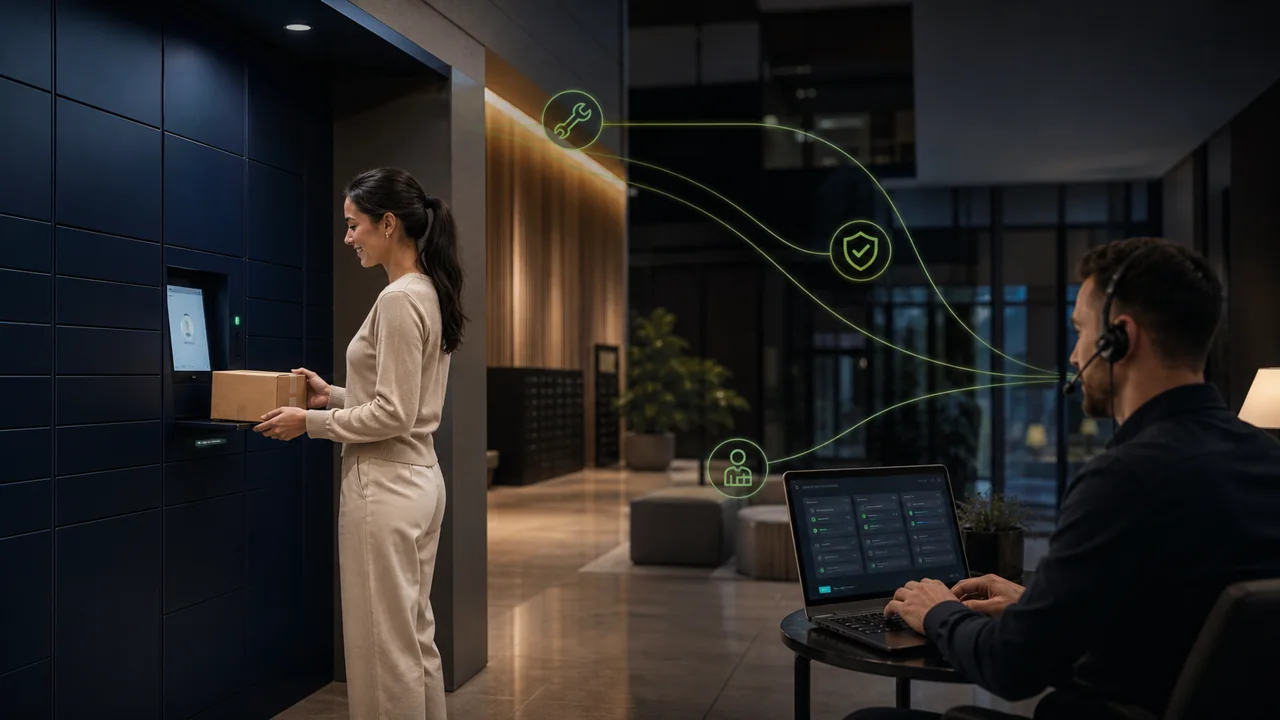
Many businesses evaluating remote maintenance for smart parcel lockers only compare software subscription costs and whether engineers need to travel. But for a terminal that is actively serving users, the biggest hidden cost may not be how long the engineer takes, but whether the remote operation occupies the pickup screen. An engineer working in the background for five minutes versus making customers unable to pick up parcels for five minutes produces completely different business outcomes.
Therefore, remote maintenance ROI should not be written simply as "how many on-site dispatches were reduced." It should also factor in engineer time, user-facing interruption, customer service and on-site assistance, as well as the impact on orders, fulfillment, complaints, and brand.
Why Screen Takeover Still Creates Downtime
Enterprise remote-control products such as AirDroid Business and TeamViewer can help engineers connect to unattended Android devices and reduce site visits. These capabilities are well suited for viewing the physical screen, exiting abnormal pages, restarting the business app, or performing system-level operations.
The problem is that when the remote operator controls the terminal's physical screen, users typically see the settings page, login page, or the engineer's taps. Even if the device network is healthy, the service entrance is occupied during that period. Some solutions can blank the screen during remote control to protect maintenance content, but a black screen also means customers cannot pick up parcels.
Teralivo's difference is that for maintenance apps that support an independent virtual display, engineers can open and operate them in the background while the physical screen continues showing the pickup business. This is not a replacement for solving all problems, but it can turn account checks, sync refreshes, and some configuration handling from "user-visible downtime" into background work.
Building a Complete Cost Formula
The following model is recommended:
Total cost per maintenance = engineer handling time cost + user-facing interruption cost + customer service and on-site assistance cost + order, fulfillment, complaint, and brand cost
Engineer costs include diagnosis, operation, logging, and review time; user interruption costs include waiting, queuing, and abandoning pickup; customer service costs include inquiries, complaints, and manual cabinet opening; on-site costs include property or maintenance personnel visits; business costs include overdue fulfillment, repeated delivery, and declining brand trust.
These items may not all be precisely converted into monetary amounts, but they must be recorded. Otherwise, a business may mistake "successful remote connection" for "no business interruption."
A Verifiable Calculation Example
Assume a business operates 2,000 smart parcel lockers, and each locker has one maintenance event per week requiring five minutes of foreground operation. Then each week may generate 10,000 minutes, or approximately 166 hours of screen occupancy.
If background operation allows 70% of these events to no longer occupy the foreground, it can reduce approximately 116 hours of potential user interruption. This does not assume engineer time disappears: engineers still need to diagnose and operate. What is saved is the portion where maintenance actions translate into customer downtime.
When calculating, peak and off-peak periods should be recorded separately. Five minutes in the evening is not the same as five minutes during the after-work pickup peak; the usage curves differ among residential areas, campuses, and office buildings.
| Metric | Physical Screen Takeover | App-Compatible Background Operation |
|---|---|---|
| Can engineer handle remotely | Yes | Yes |
| Do customers see maintenance pages | Usually yes, or see a black screen | Foreground can stay on pickup screen |
| Suitable for system-level failures | More suitable | Limited capability |
| Requires app support for independent display | No | Yes |
| Primary value | Reduces on-site travel | Also reduces user interruptions |
What Data to Record During a Pilot
Do not extrapolate the entire device fleet directly from a marketing demonstration. Choose real terminals with different models, Android versions, network environments, and business volumes, and continuously record failure types, remote connection success rates, average handling time, foreground occupied time, the proportion requiring on-site intervention, and recurrence after recovery.
Also mark whether the target app supports an independent virtual display. If the app must use a physical camera, secure keyboard, specific hardware acceleration, or external devices, background display may not be able to perform all operations. In that case, traditional physical screen remote control and maintenance windows should be retained, rather than forcibly assigning all faults to background processing.
How to Compare Teralivo with Full MDM
Full MDM's advantages typically include device enrollment, grouping, app distribution, version rollout, kiosk policies, security restrictions, geofencing, and bulk configuration. Teralivo should not be described as a complete replacement for these capabilities. It is better positioned as a focused background remote operation entry point that addresses the question, "When maintaining a compatible app, is it necessary to interrupt the customer?"
Procurement decisions can use a combination approach: use an MDM for device lifecycle and policy management, use traditional remote control for physical screen or system-level faults, and then use Teralivo for background processes that can be completed in an independent display. The final basis should be pilot data, not the number of features.
The Core of ROI Is Not Buying Fewer Tools
The truly valuable outcome is minimizing the impact of a remote maintenance event on customers, customer service, and on-site operations. As long as the terminal is still providing pickup, payment, or check-in services, the foreground screen is a production resource. The business value of background maintenance comes from keeping this resource available while engineers work.